
What Is the Standard Business Card Size in the UK?
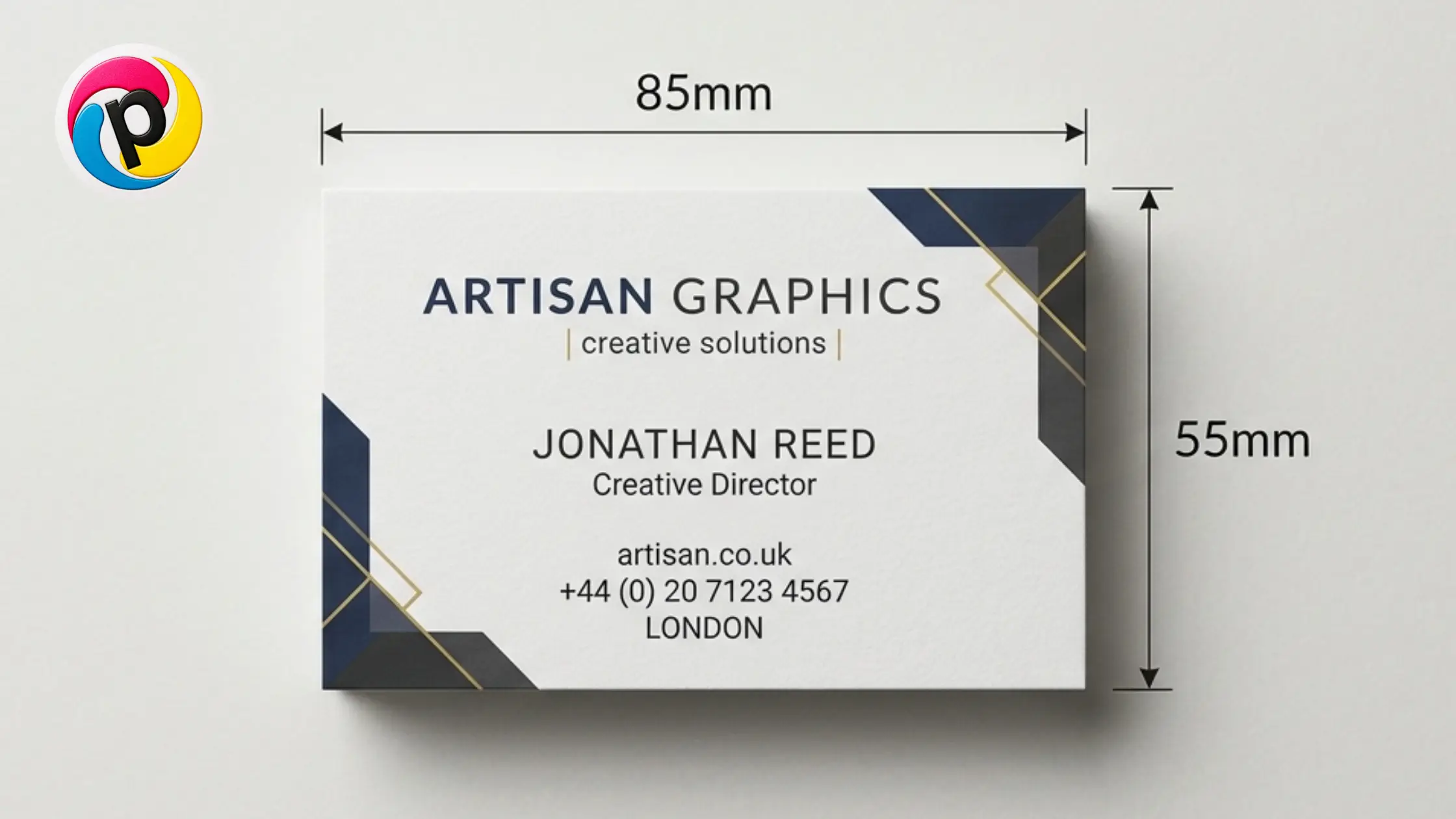
If you’re preparing artwork for print, one of the first questions you may ask is what is the standard business card size in the UK? The most commonly used finished size is 85mm × 55mm.
This compact format is widely used across the UK because it fits comfortably into wallets, card holders and pockets while still giving you enough space for essential contact details and branding.
If you’re designing your own business card, however, the finished size is only part of the setup. You also need to allow for bleed, keep important information away from the trim edge and make sure your text remains readable at the finished size.
What Is the Standard UK Business Card Size?
The standard finished business card size in the UK is:
- Width: 85mm
- Height: 55mm
- Orientation: Landscape or portrait
Landscape is the most common format, but portrait business cards use exactly the same dimensions, simply rotated to 55mm × 85mm.
The size can differ from business cards used in other countries, so it’s worth checking the dimensions if you’re downloading a template or using design software with international presets.
What Size Should My Business Card Artwork Be?
If the finished business card is 85mm × 55mm, your artwork should normally be slightly larger to include bleed.
At Printpal London, we recommend 3mm bleed on every edge. This means the supplied artwork should measure:
- 91mm × 61mm including bleed
- 85mm × 55mm finished size after trimming
The extra 3mm around the outside is trimmed away during production. Any background colours, photographs or design elements intended to run to the edge of the card should extend fully into this bleed area.
For a more detailed explanation, read our guide on how much bleed business cards need, including how to set up the complete 91mm × 61mm artwork area.
Why Does Bleed Matter on Business Cards?
Commercial printing and trimming involves a small production tolerance. Bleed helps prevent an unwanted white edge appearing if the cut varies slightly from the artwork position.
For example, if your card has a black background that runs right to the finished edge, the black background should continue another 3mm beyond the trim line.
Without bleed, even a small movement during trimming could leave a thin white edge along one side of the finished card.
What Is the Safe Area on a Business Card?
As well as adding bleed outside the finished size, you should keep important information safely inside the trim line.
Names, telephone numbers, email addresses, logos and other essential details shouldn’t sit too close to the edge. As a practical guide, keeping important content around 5mm inside the finished edge gives your design comfortable breathing room and reduces the risk of text appearing too close to the trim.
This is particularly important for small text, fine borders, QR codes and logos.
What Size Font Should You Use on a Business Card?
Because a business card is only 85mm × 55mm, typography needs to be considered at its actual printed size rather than judged from a design enlarged on a computer screen.
As a general starting point, around 8pt to 11pt can work well for many contact details, while names and other important information can be larger depending on the typeface and layout.
For more practical guidance, see our guide to what size font you should use on a business card.
What Should You Put on a Business Card?
The limited space doesn’t mean you need to squeeze as much information as possible onto the card.
Most professional business cards only need the essential details, such as your name, role, company, telephone number, email address and website. Optional information such as a QR code or social media details can be added where they’re genuinely useful.
Our guide on what you should put on a business card explains which details are worth including and what can usually be left out.
Should You Add a Border to a Business Card?
You can use a border, but very thin borders positioned close to the edge can be difficult to keep visually even once the card has been trimmed.
Small production tolerances that are barely noticeable on a normal design can become much more obvious when there’s a narrow border running around all four sides.
If you do want a border, it’s usually better to make it reasonably wide and position it comfortably inside the trim area.
Landscape or Portrait: Which Business Card Size Is Better?
There’s no difference in the actual finished dimensions. A landscape card measures 85mm × 55mm, while a portrait card measures 55mm × 85mm.
The best option depends on your design and the information you need to include.
Landscape cards work particularly well for traditional contact layouts, while portrait cards can suit simpler branding, logos or more design-led layouts. Neither format is inherently better from a printing point of view.
Should a Business Card Be Single or Double Sided?
The finished size remains 85mm × 55mm whether you print one side or both.
Using both sides can give you more space to separate branding from contact information. For example, you could place your logo on the front and your name, telephone number, email address and website on the reverse.
If you’re deciding how to structure the design, see our guide on whether business cards should be single or double sided.
What File Format Should I Supply for Business Card Printing?
For professional printing, a print-ready PDF is normally the safest option. Your artwork should be set to the correct size, include the required bleed and have all important information positioned within the safe area.
Images should also be suitable for print resolution, and artwork intended for commercial printing should generally be prepared in CMYK rather than relying on RGB screen colours.
If you’re unsure about the difference, our guide on whether business cards should be CMYK or RGB explains why screen colours and printed colours shouldn’t be assumed to reproduce in exactly the same way.
Business Card Printing in London
If you already have artwork prepared at the correct dimensions, Printpal London offers professional business card printing in London for businesses, designers and individuals.
We print standard UK business cards at 85mm × 55mm and offer different card stocks and finishing options depending on the specification and turnaround you require.
For urgent requirements, same-day business card printing is also available on selected specifications when payment and print-ready artwork are received within the required production cut-off.
Business Card Size Checklist
- Finished size: 85mm × 55mm
- Portrait size: 55mm × 85mm
- Artwork size with 3mm bleed: 91mm × 61mm
- Recommended safe area: Keep important content around 5mm inside the trim edge
- Preferred file: Print-ready PDF
- Images: Ideally around 300dpi at final printed size
- Colour setup: CMYK for commercial print
Final Thoughts
So, what is the standard business card size in the UK? The most commonly used finished size is 85mm × 55mm.
When preparing your artwork, remember that the supplied file should normally be 91mm × 61mm when 3mm bleed is included on every edge. Keeping important information safely inside the trim line and checking the design at its actual printed size will also help you create a balanced, practical business card.
If your artwork is ready, explore our business card printing in London service to choose your stock, quantity and turnaround.