
Should Business Cards Be CMYK or RGB?
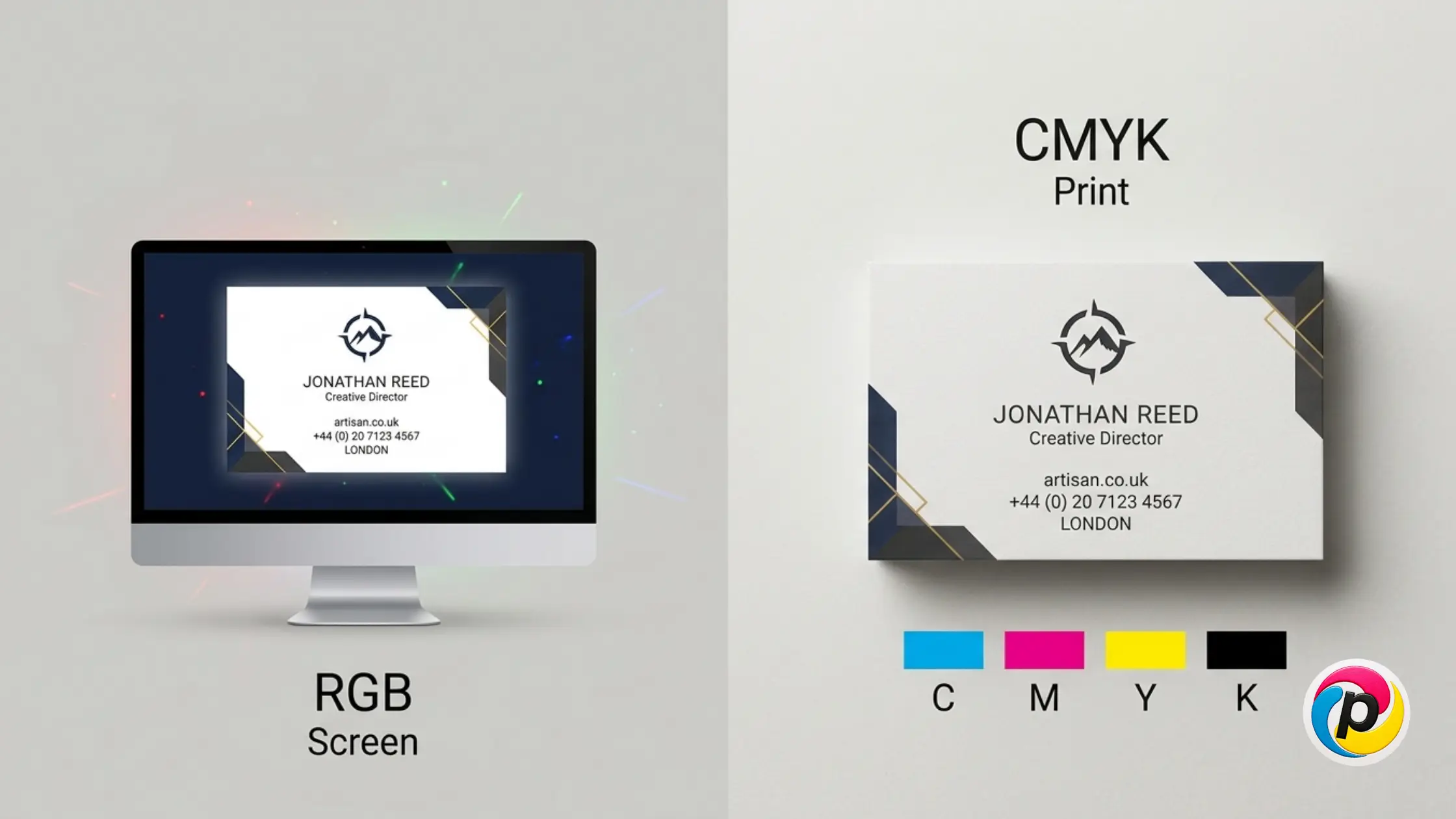
If you’re preparing artwork for professional printing, you may be wondering should business cards be CMYK or RGB? For commercial printing, business card artwork should generally be prepared in CMYK rather than RGB.
RGB is primarily used for screens, while CMYK is the colour model commonly used for full-colour commercial printing. Understanding the difference is important because a colour displayed on your phone or computer shouldn’t be assumed to reproduce in exactly the same way when printed.
What Is the Difference Between CMYK and RGB?
RGB stands for Red, Green and Blue and is used by digital displays such as monitors, phones, tablets and televisions.
These devices create colour using light.
CMYK stands for Cyan, Magenta, Yellow and Key, with Key referring to black. These process colours are commonly used to produce full-colour commercial print.
Because one system uses emitted light and the other produces colour on a physical material, they don’t reproduce every colour in exactly the same way.
Should Business Cards Be CMYK or RGB for Printing?
For professional business card printing, CMYK is the recommended colour mode.
Preparing your artwork in CMYK gives you a more appropriate representation of the colour space available to the printing process and reduces reliance on a later RGB conversion.
Why Can RGB Colours Look Different When Printed?
A screen produces colour using light, while printed artwork is viewed by light reflecting from the physical paper or card.
RGB screens can display some colours that standard CMYK printing can’t reproduce in exactly the same way.
Very bright and highly saturated RGB colours are common examples.
Will My Printed Business Card Match My Screen Exactly?
No ordinary phone, tablet or computer screen should be treated as an exact physical print reference.
Displays vary in brightness, technology, calibration, colour settings and viewing conditions. The same artwork can look different on two different screens before anything has even been printed.
Paper stock and finishing can influence the completed appearance too.
Our guide to the best paper for business cards explains how coated and uncoated materials can differ.
What Happens If I Send an RGB Business Card File?
An RGB file will generally need to be converted into a colour space suitable for commercial printing.
During conversion, colours outside the printable CMYK range may change. Sometimes the difference is relatively small; with very bright RGB colours it may be more noticeable.
Does CMYK Guarantee an Exact Colour Match?
No. Using CMYK is an important part of preparing artwork correctly, but it doesn’t guarantee an exact match to a screen or another previously printed item.
The completed appearance can also be influenced by:
- The paper or card stock
- Whether the material is coated or uncoated
- The printing process
- The finishing
- The artwork’s colour profile
- Lighting conditions when viewing the finished card
What Colour Profile Should I Use?
For artwork supplied to Printpal London, we recommend preparing commercial print files in CMYK using the Fogra39 colour profile where possible.
If you’re working with a professional designer, they should be able to prepare and export the final print-ready PDF using an appropriate CMYK workflow.
What Else Should I Check Before Sending Business Card Artwork?
- Finished size: Standard UK business cards are 85mm × 55mm.
- Bleed: We recommend 3mm on every edge.
- Safe area: Keep important information comfortably inside the trim.
- Resolution: Raster images should ideally be around 300dpi at final printed size.
- Fonts: Make sure fonts are correctly embedded or outlined where appropriate.
- File format: Supply a properly prepared print-ready PDF.
For artwork dimensions, read our guides to the standard business card size in the UK and how much bleed business cards need.
Business Card Printing in London
Once your artwork is prepared, Printpal London offers professional business card printing in London with a range of card stocks, quantities, finishes and turnaround options.
For the most appropriate workflow, we recommend supplying print-ready CMYK artwork rather than relying on the appearance of an RGB design displayed on a screen.
CMYK vs RGB Business Cards: Quick Guide
- RGB: Primarily designed for digital screens.
- CMYK: Used for standard full-colour commercial printing.
- Recommended for business card artwork: CMYK.
- Printpal colour profile: Fogra39 where possible.
- Screen matching: Don’t assume printed colour will exactly match a phone or monitor.
- Paper: The selected stock can influence the finished appearance.
Final Thoughts
So, should business cards be CMYK or RGB? For professional commercial printing, business card artwork should generally be prepared in CMYK.
RGB is intended primarily for screens and can contain colours that standard CMYK printing can’t reproduce in exactly the same way. Preparing your artwork in CMYK from the beginning provides a more appropriate starting point for commercial print.
When your artwork is ready, explore our business card printing in London options for available stocks, quantities and turnaround times.