
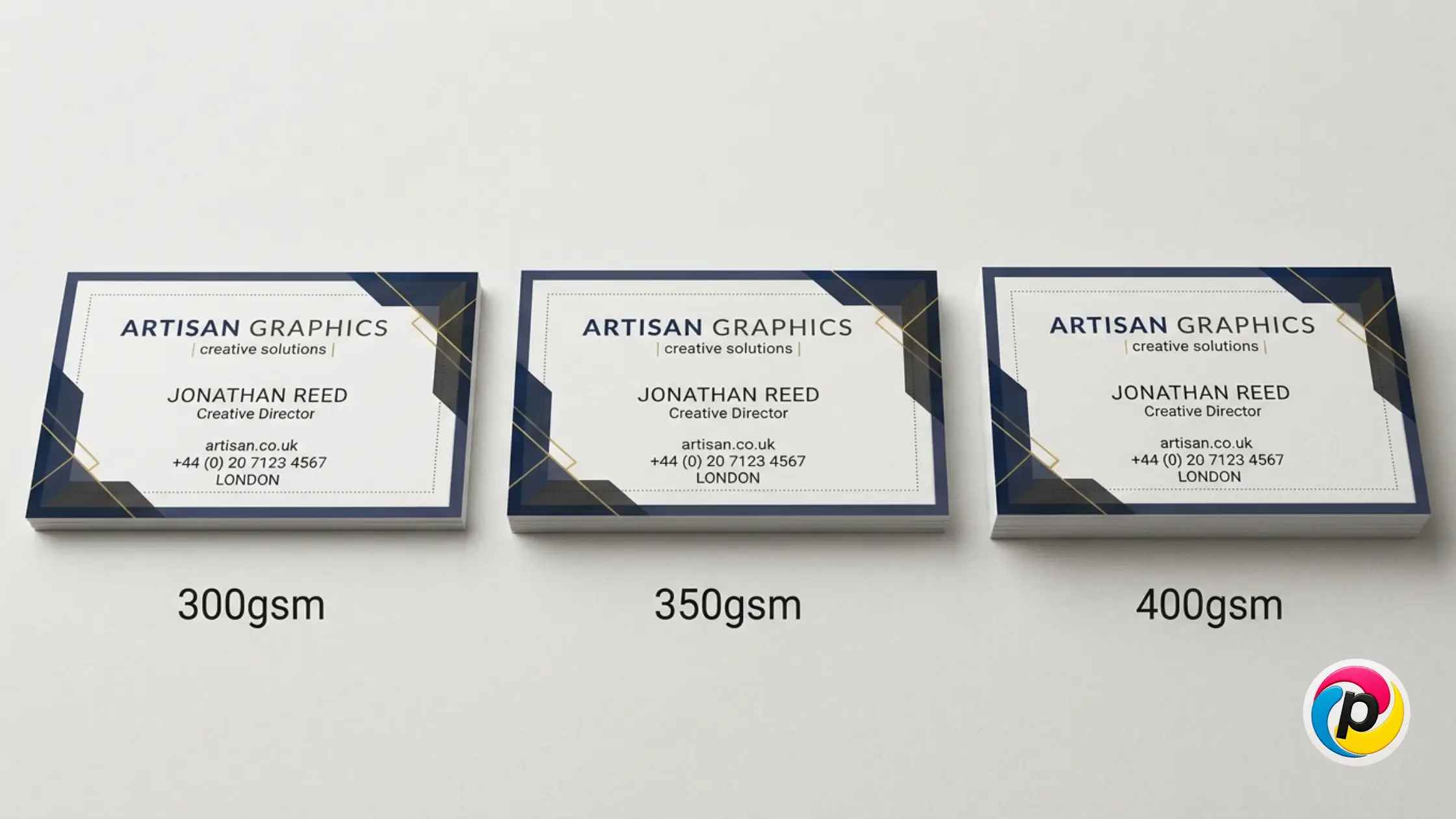
What GSM Is Best for Business Cards?
If you’re choosing a paper stock for your next set of cards, you may be wondering what GSM is best for business cards? There isn’t one weight that’s right for every design, but professional business cards are generally produced on substantially heavier stock than everyday paper.
For most professional applications, 350gsm and above is a good place to start. The right choice ultimately depends on the paper itself, the design, the finish and how you want the completed card to feel.
What Does GSM Mean on Business Cards?
GSM stands for grams per square metre. It’s a measurement of the weight of the paper or card rather than a direct measurement of its thickness.
As the GSM increases, the material will generally feel heavier and more substantial. However, two materials with the same GSM don’t necessarily have exactly the same thickness or feel.
The composition, coating and manufacture of the stock can all influence its characteristics, so GSM should be treated as a useful comparison rather than an exact measurement of thickness.
What GSM Is Best for Business Cards?
For most professional business cards, we’d generally recommend looking at card stocks of around 350gsm and above.
A 350gsm card provides a substantial feel while remaining practical for everyday business use. Heavier stocks are available for certain specifications, but choosing the highest GSM doesn’t automatically mean you’ll get the most suitable card.
The paper surface, artwork and finishing should all be considered alongside the weight.
Is 350gsm Good for Business Cards?
Yes. 350gsm is a popular choice for professional business cards because it provides a good balance between weight, practicality and presentation.
It’s substantially heavier than normal office paper and works well for cards handed out at meetings, exhibitions, networking events and everyday customer interactions.
If you’re deciding between different materials rather than weights alone, our guide to the best paper for business cards explains how coated and uncoated stocks can differ.
Does Higher GSM Always Mean a Better Business Card?
No. A higher GSM doesn’t automatically make a business card better.
The artwork, stock, printing method and finishing all contribute to how the completed card looks and feels.
A well-designed card produced on a suitable 350gsm stock can be more appropriate than a substantially heavier card that doesn’t complement the design or intended use.
GSM and Thickness Are Not the Same Thing
One common misconception is that GSM tells you exactly how thick a business card will be.
It doesn’t.
GSM measures weight per square metre, while thickness is normally measured separately in microns or millimetres. Different materials can have different densities, meaning two 350gsm stocks may feel slightly different even though their stated weight is the same.
Does the Finish Affect How the Card Feels?
Yes. The surface finish can have a significant effect on how a business card feels in the hand.
Matt, gloss and soft touch finishes each have different characteristics even when applied to a similar base stock.
If you’re comparing conventional finishes, see our guide on whether business cards should be matt or gloss. For a more tactile option, we’ve also explained what soft touch lamination is on business cards.
What Else Should I Consider When Choosing Business Cards?
Alongside GSM, consider:
- Paper stock: Coated and uncoated stocks have different surfaces and characteristics.
- Finish: Finishing can noticeably change the surface feel of the card.
- Design: Some materials complement particular artwork styles better than others.
- Turnaround: Specialist stocks and finishes may require additional production time.
- Quantity: The most suitable production method can depend on how many cards you require.
What Size Are UK Business Cards?
The standard UK business card size is 85mm × 55mm. The physical dimensions don’t change simply because you select a heavier card.
If you’re preparing artwork yourself, read our guide to the standard business card size in the UK.
You’ll also need to allow for trimming. Our guide on how much bleed business cards need explains the recommended 3mm bleed around every edge.
Business Card Printing in London
Printpal London offers professional business card printing in London with different stocks and finishing options depending on your specification and turnaround.
Rather than choosing purely by the highest GSM available, consider the complete card: its material, surface, design and intended use.
Final Thoughts
So, what GSM is best for business cards? For most professional applications, 350gsm and above is a sensible starting point, but GSM shouldn’t be the only factor in your decision.
The stock itself, surface, finishing and intended use all contribute to the finished result.
Explore our business card printing in London options to compare available specifications for your next order.